Awarded Editors Choice IIID Awards 2011
International Institute for Information Design
an investigation of the role of the visual communication designer in the representations of place
Awarded Editors Choice IIID Awards 2011
International Institute for Information Design

Abstract for Institute for Australian Geographers University of Wollongong Tuesday 5 July 2011 Jacqueline Gothe, Teresa Leung, Richard Lim, Yin Phyu, Roel Plant, Scott Rayburg, Jeremy Walker
This paper will discuss the critical practices and processes of visual communication design manifestations in an ongoing research project. It uses as its starting point a current study into the combined toxicity effects of three pesticides on a range of freshwater species found in coastal rivers of NSW, including the Hawkesbury-Nepean River. The team comprises ecotoxicologists (who developed the methodology and carried out the field and laboratory work to generate the results which underpinned this component of the study); a social scientist, a geomorphologist, and a geographer; and two visual communication designers and key stakeholders including scientists, policy makers and regulators. The design team used a participatory, user-based framework, which involved collaborative decision making.
At the meta-level the questions for the design team are i) how better integration practices can be developed and understood through an examination of the perceptions of design within a multi-disciplinary team; and ii) how design can effectively engage with a team unfamiliar with design or the design process, particularly in developing communication strategies. In the context of this project this question is being asked through practice – the practice of design, the practice of collaboration, the practice of multi-disciplinarity and the possibility of transdisciplinary practices.
The practice question for the research team is: how do we communicate research findings to the relevant communities on the Hawkesbury-Nepean River to encourage changes in pesticide usage?
The project was carried out over two stages. The first stage comprised deep engagement with the findings from the ecotoxicological research in order to understand and develop a prototype that communicates these findings and their implications in developing and refining water quality guidelines in Australia. Field trips to conduct interviews with stake holders, desk top research and regular team meetings were conducted to progress our understandings of the implications of the findings through collaborative processes of analysis and feedback. This stage is documented in a paper that elucidates a direction based on stakeholder interviews. This interview structure used among other things a visual mapping process. This mapping activity was designed to create a picture of the perceptions of different stakeholders and their understanding of the roles and responsibilities in the management and regulation of the use of pesticides on the Hawkesbury-Nepean River.
The second stage takes its direction from the outcomes of Stage I and focuses on policy makers and government bodies as a potential entity of change. The communication prototype was designed after extensive consultation with the ecotoxicologists. This was tested over several iterations initially within the team and then with policy makers, science communicators and scientists. The engagement process –interview, feedback and discussion on the prototype – was viewed as an intervention. This process created a snowballing effect which allowed interaction with stakeholders who were previously inaccessible. Conceptual and procedural flexibility was identified as a key challenge particularly as advocacy became an embedded value.
The final stage of the process is to design a one day workshop with the stakeholders where the results of the multi disciplinary research will be presented and discussion about ways forward in terms of research – the importance of scientific monitoring, the value of an ongoing trandisciplinary focus and the value of design practice in these contexts.
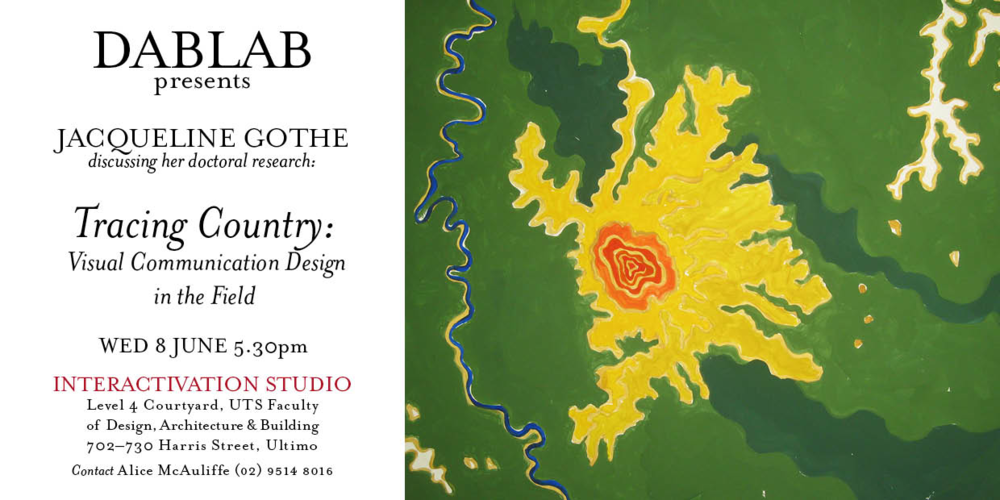
Jacqueline Gothe will discuss her doctoral research. This study interrogates three practices of visual communication in a university context and articulates a framework for the creative practitioner, the designer and the researcher in the discipline of visual communication.

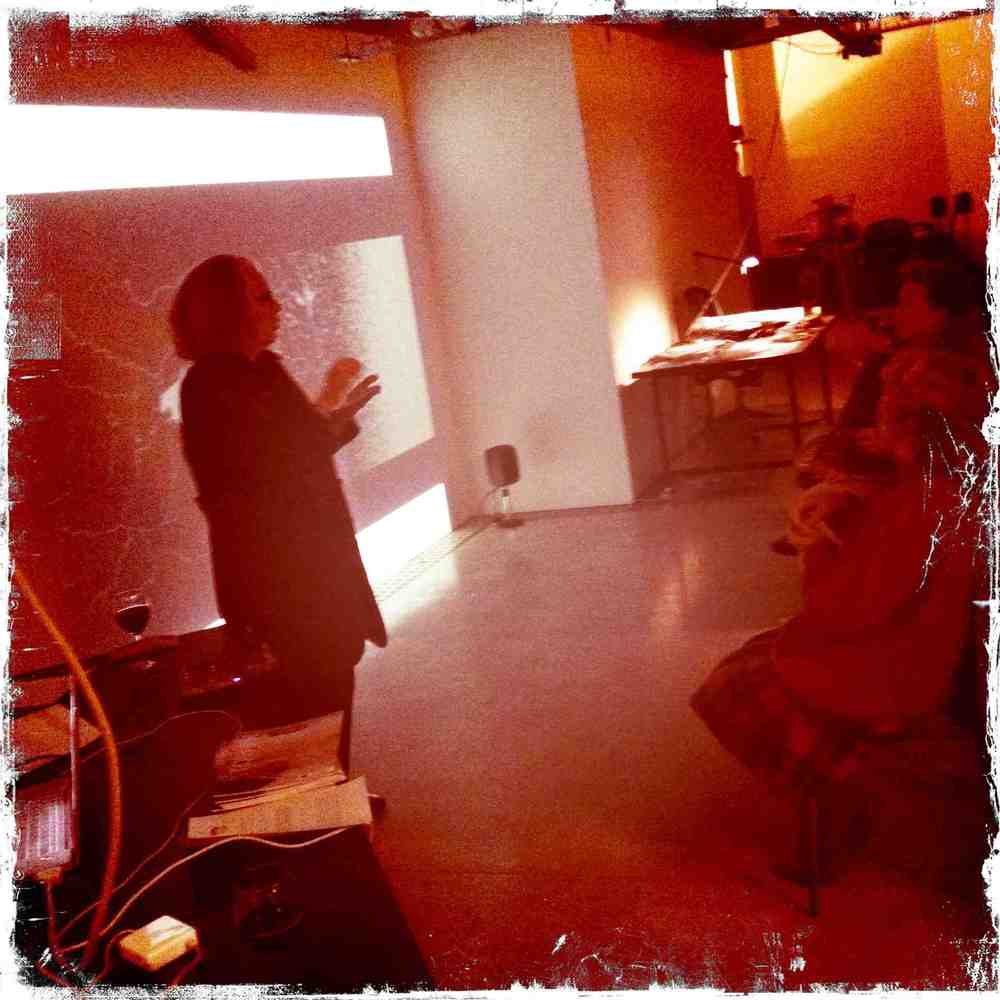

Thanks to Sean Callinan for the images.
It was great to present some of the thinking from the doctoral research Drawing Country. There were some pertinent questions and I will be adding erasure to my critical tracing strategies.
• mimesis
• repetition
• erasure
• transparency
• overlay
• rupture
• transformation
“She is able to move within place as place. Within the availability of place. Given that her issue is how to trace the limits of place herself so as to be able to situate herself therein and welcome the other there.”[1
The practice of chōrography
• Tracing the Trace – a critical practice
Chorography is defined as ‘the tracing or describing of particular regions with consideration of aesthetic criteria.’
It is this that is my starting point and begins to focus my course of action and conduct. It is a way of proceeding along a path – sometimes following and at other times leading
Tracing allows me to walk the beaten path through a wild or unenclosed region, made by the passage of water and earth; the track or trail made clear by a line that gives sense to the landscape. Rather than walking country I am drawing country in order to understand better the country.
The method offers a way of working that allows the knowledge and observation of place – the maps, information and knowledge to reside and inhere in my drawing practice. It is a surrogate walking and becomes a dance as I move from the role of designer to artist and back again in an infinite loop.
Chorography respects the act of tracing because the act of tracing respects the ground that the act emerges from. It is not a mechanical act. The metaphor of the machine is unacceptable and inappropriate as the humaneness and humanness of the aisthetic experience acts as the motivator for the engagement. Openness respect and responsiveness to the other as a designer. as the designer engages in relations, communities and participants stakeholders to understand the needs and requirements of the translation. it is not a machine. Tracing is the drawing, delineating, marking out; the engaging with the ‘complex artefact’ (Scazzozi 2011 pg 9) by means of a transparent sheet placed over it. This act is multi intentioned – to capture, to reproduce, to copy, to change, to understand and create a opening of understanding in the case of the designer for the participants and in the case of the creative practitioner an aesthetic experience in the performative act of making.
Deleuze and Guattari and Deleuze in Logic of Sensation describe the aesthetic ordering as through layer – ’drawing, strata, the earth
A ‘stubborn geometry’ the measure of the world – all acts of perception refer to the making sense of the experience. It It itself creates its own striation which we will examine in ‘Drawing County chapter.
Tracing in graphic design pre–digital was a process that allowed for multiple examining of composition, structure and also re-use, re-adjustment and reconfiguration, supported scaling comparison and evaluating Tracing recognizes the complexity of image through layering, shifting, removing, adding. The tracings of chora|graphia are not mechanical copies rather it is connection between layers of understanding and reconfiguring through an aesthetic sensibility the stages of change. It is a critical act of mediation that may provide a ‘line of flight’ (Deleuze and Guatarri 1987 pg 15) towards an opening or transformation.
• Critical tracing strategies
Deleuze and Guattari offer sobering reservations about tracing but do recognize that in tracing there is a possibility ‘an intensive trait starts working for itself, a hallucinatory perception, synesthesia, perverse mutation, or play of images shakes loose, challenging the hegemony of the signifier…gestural, mimetic, ludic and other semiotic systems regain their freedom and extricate themselves from the ‘tracing’ (through the act of tracing).’
Tracing as mimesis, repetition, transparency, overlay, erasure, rupture and transformation in the context of an intensive trait have been identified as critical tracing strategies in relation to the experiences on country that provide translations that provide a line of flight for the user and the maker.
‘the relationship with the other is time: it is an untotalizable diachrony in which one moment pursues another, without ever being able to retrieve it, to catch up with it, or coincide with it. The non-simultaneous and non-present are my primary rapport with the other in time. This means that the other is forever beyond me, irreducible to the synchrony of the same. The temporality of the inter-human opens up the meaning of otherness and the otherness of meaning.’[2]
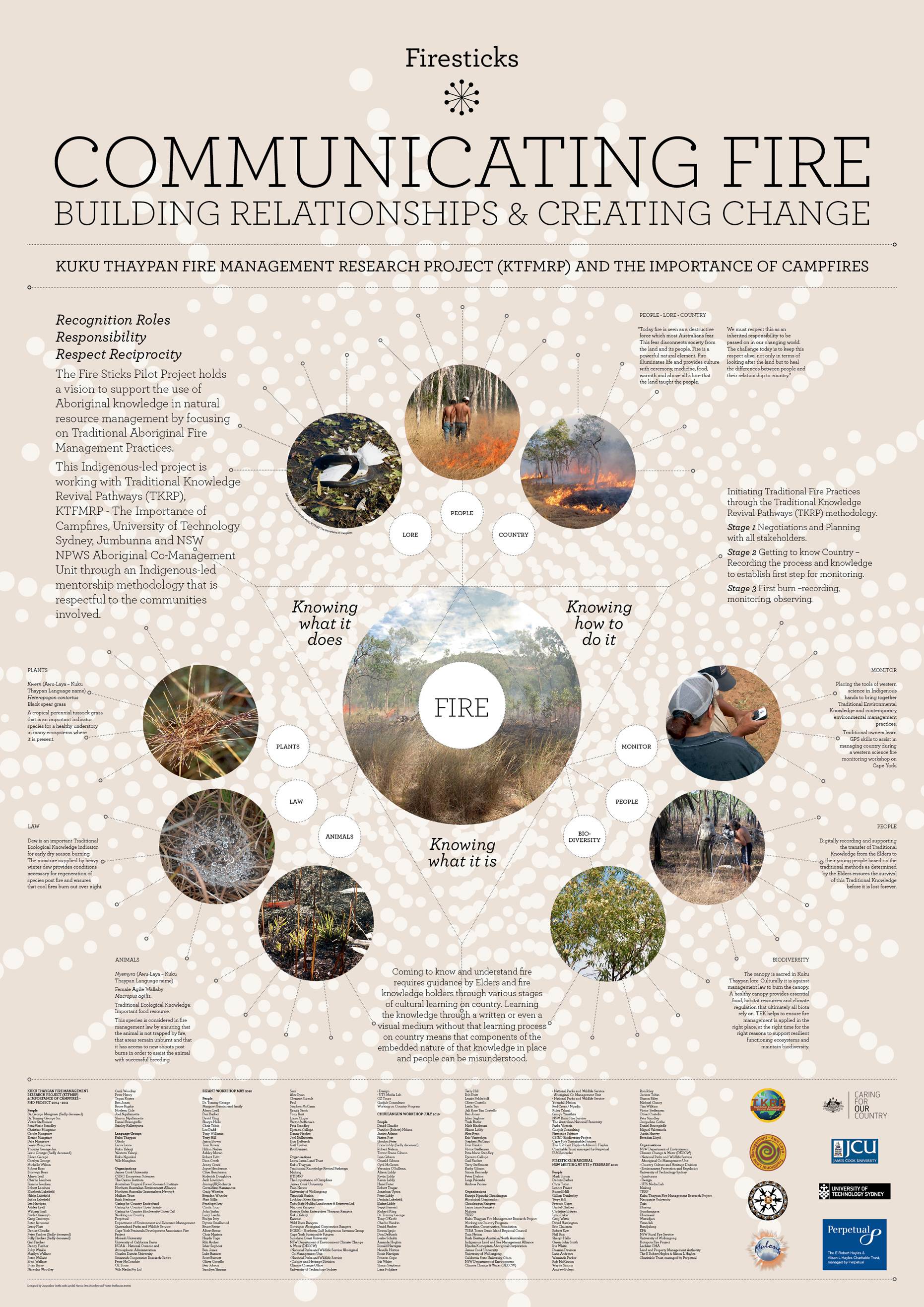
The visual communication designer/chorographer works in a landscape context but is required to negotiate the communication of place/country with stakeholders in a participatory process. To allow these experiences to become objects of study [scarr] is the tracing strategy. Fire, water and country – are the experiences that form the case studies. Firesticks an indigenous -led project initiated by the Kuku thaypan Elders in Cape York, communication design for the Corangamite Regional Catchment Authority and Transdisicplinary engagemnts in the Hawkesbury Nepean Catchment and the creative practiuce Drawing Country(2008- 2012) that includes exhibitions, collaborative installations and a studio practice that is invisible.
The choragrapher is the researcher and works in and understands the meta – landscapes of the context of the study through scholarly reflection – in this case the relationship between the limits and possibility of sustainment, visual communication design, and aisthesis in the context of creative practice research. It is the reflective and reflexive layer of the study. This is understood through using the tracing strategies of mimesis, transparency, overlay, rupture and transformation to make sense of the connections and differences between the experiences and to make sensible the chaos of the experiences through a commitment to a classical theory of perception – I perceive from the senses and the intellectual simultaneously.
The chora|ographer understands landscape from the perspective of a visual communication creative practitioner – inward and experimental, but ‘not the private performance of a secluded mind operating on sense data exclusively its own’ (Straus and Griffiths 1967 pg 11), rather a synthesis of the experiences of place|country through a critical tracing process.
Louis Dupre responding to the duality of Tomas’s understanding of the aesthetic experience who takes a physicalist view of perception, in 1967 at Fourth Lexington Conference on Pure and Applied Phenomenology Aisthesis and Aesthetics states:
Aesthetic perception is neither ordinary perception nor pure reflection. It combines the detachment of the latter with the intuitive immediacy of the former. (pg 172)
This could be a state of co-existence or a transitional state which Kant claimed as the imagination ‘between sense experience and objectified experience’ (ibid)
Mikael Dufrenne posits that the imagination detaches the object from the live experience by a means of a process of temporalisation.
To imagine is to place things under the concrete universality of time and to detach them from the sensory present.
To withdraw from the game is to take refuge in the past…
To contemplate is to return to the past in order to capture the future;
I only cease to be one with the present object when I detach myself from a present in which I remain immersed in thing. The re- of representation expresses this interiorization, just as the con- of contemplation expresses the possibility of a survey and a simultaneity which evokes space.
(Quoted in Dupre p172 Mikael Dufrenne Phenomenologie de l’experience esthetique Vol 11 Paris 1953 p434)
Dupre suggests the imagination temporalises in two ways – empirically and transcendentally.
It is not in a world; it constitutes a world and this world is within the experience. (Dufrenne op.cit p 449 quoted in Dupre p173)
Dupre argues for a co-existence of the empirical or the everyday and the transcendental.
No work of art then can claim full aesthetic immanence – the intentional reference to the world of ordinary perception is an intrinsic part of all aesthetic experience.
Aesthetic perception is never pure perception but a perception coloured by a subjective disposition. Schleiermacher regarded the aesthetic experience as an awareness of the self with the object, a conscious merging of subject and object, rather than a perception of an object. The merging of the self with its object is usually referred to as a feeling.
Johannes Volkelt Versuch uber Fuhlen and Wollen 1930 p12 “Ein unmittelbares Sichselbsterleben des Ich in seiner Ichheit’*
– certain elements are always present in feelings – an experience of pleasure or displeasure, an experience of corporeality; explicit or implicit representations – all these elements are co-ordinated by a predominant experience of the self as such.*
This self experience is not cognitive; it is a totality experience which i am aware of the self as it is united with the universe as a whole. – it is an immediate presence to oneself distinct from the reflective presence of action and cognition. Yet the immediacy of feelings does not imply that they are superficial: unlike sensation and emotions, feelings presuppose a reflective presence to the world. That is why feelings reveal and emotions react.
The revealing quality of feelings consists in their ability to read appearances as expressions of a subject, and to do so with the immediacy of ordinary sense perception. because they are subjec oriented, feelings do not follow a logical pattern in anticipating the course of future events. The ultimate ground of these noetic characteristics is the total involvement of the self. Only by a direct participation of the slelf can an appearance ever be viewed as the expression of another self. This self-involvemnt of feelings, however is in no way a committment. The self never gives itself in feeling, nor does the object of feeling ever need any giving. For the two are one in an immediate way without the dialectical opposition between giving and wanting that we encounter in love. Through feeling, the aesthetic object ceases to be an object in the strict sense: it becomes interiorized in the subject An object is made aesthetic by the contemplating subject.
…the aesthetic structuring of this feeling. No feeling is fully aesthetic until it is expressed. We may say, then, that the aesthetic feeling is born in its expression.(op.cit p176)
Read on Sunday 22 May 2010 Louis Dupre ‘Aesthetic Perception and its relation to ordinary perception’ p171-177 from Aisthesis and Aesthetics The Fourth Lexington Conference on Pure and Applied Phenomenology 1967
Delivered 9.00am Friday April 71967 Panel: Aesthetic Creation

Cezanne -Deleuze Liz Grosz Daniel Smith
Harmon Chapman in his paper for ‘ Aisthesis and Aesthetics’ the Fourth Lexington Conference on Pure and Applied Phenomenology in 1967 argues for the classical theory which regards perception as ‘the dual actualisingof both self (mind) and other (world) as opposed to modern theory – post – Descarte which regards perception as a private process of constitution which estranges the other and reduces the self to an anonymous observer of its own fabrications.’
He refers to Plato’s Theory of Knowledge as the foundational understanding of sense perception. This theory according to Cornford contains elements borrowed from Protagorus and Heraclitus. He claims that the ‘principal thesis is Heraclitean: “everything is motion (or change)”, that is, what we ordinarily call objects are really processes. This thesis is supplemented by three divisions of motions into kinds;
1. change of place and change of quality
2. fast and slow motions
3. motions which have the power of acting and those which have the power of being acted on ie. the “power’ of responding to the former as cause or stimulus.
Socrates concludes from all this ‘that nothing is one thing just by itself, but is always in process of becoming for someone, and being is ruled out altogether
Aristotle – ‘prior to sense perception things are only ‘potentially’ sensible, after sense perception they are ‘actually’ sensible.
As a practitioner of an aesthetic practice (Stewart The Open Studio) I am interested in the sensorial – the pre-rational – what Kristeva calls the semiotic and Deleuze refers to according to Daniel Smith who translated the Logic of Senses a recognition of the simultaneity of sensation and perception and Grosz invokes as ‘irridescent chaos’.
“The pre-rational world of sensation is not ‘prior’ to the world of perception or representation but strictly speaking is co-extensive’ with it. (Smith Logic of Sensationpg xiv)
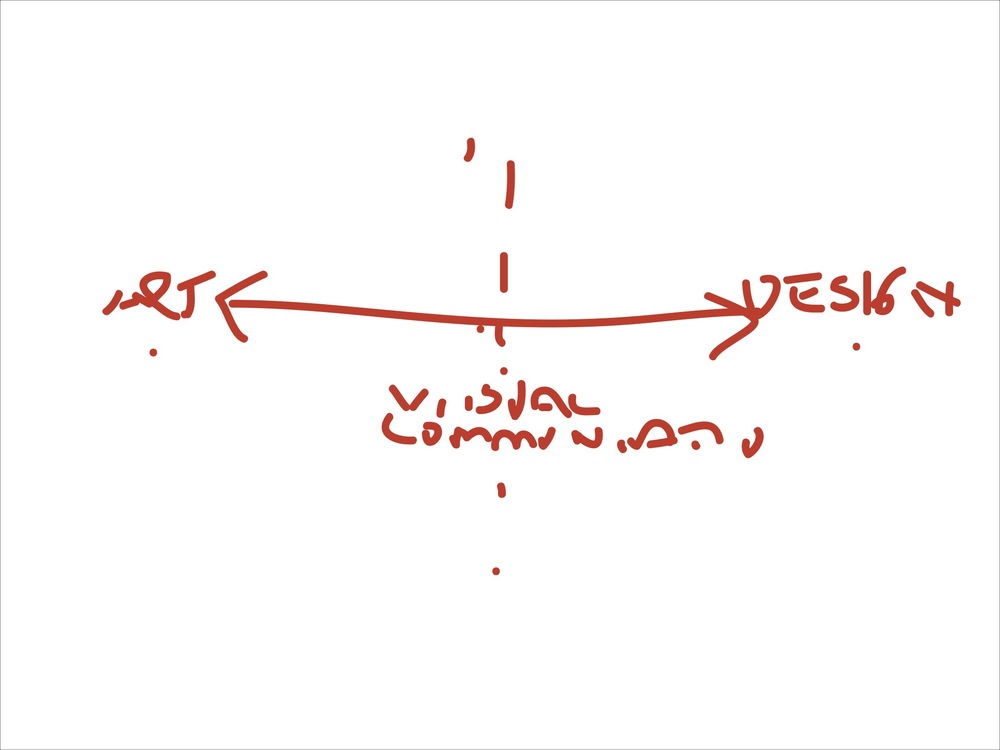
Somewhere between art and design lies visual communication. The practices of graphic design, communication design, information design, media arts, advertising all have a place in visual communication but there is another practice called chorographia that advocates for sustainment by creating and engaging in an experience of the aesthetics of place. Drawing, painting, photography, cartography, mapping, diagramming, tracing are all ways of representing landscape. The aesthetic of place in this project Drawing Country is understood as a connection between knowledge, experience and people.

Erwin Straus (1891-1975), a phenomenologist and neurologist of European origin, helped to pioneer anthropological medicine and psychiatry, a holistic approach to medicine that is critical of mechanistic and reductionistic approaches to understanding and treating human beings.
In 1967 speaking at Aisthesis and Aesthetics the Fourth Lexington Conference on Phenomenology: Pure and Applied and quoted in the conference proceedings:-
Referring to my house or my gloves or my country or my university, to my friends or my enemies, if any, I am referring to a kind of partnership between house and owner, father and son, country and citizens. It seems that there is but one exception: only in reference to my body there is no partner – at least so it appears. Indeed there is a partner, nothing remote or concealed: just the opposite. The partner is a commonplace in the literal sense of the word. For my partner – and the partner of each one of you – is the Earth, which may well be spelled here with a capital E. In our primary experience, unaffected by the teachings of Copernicus and modern astronomy, the Earth is the timeless ground, resting in its apparently effortless power. This certainly is a formidable partner! (pg 139)
 placetracing | Jacqueline Gothe